
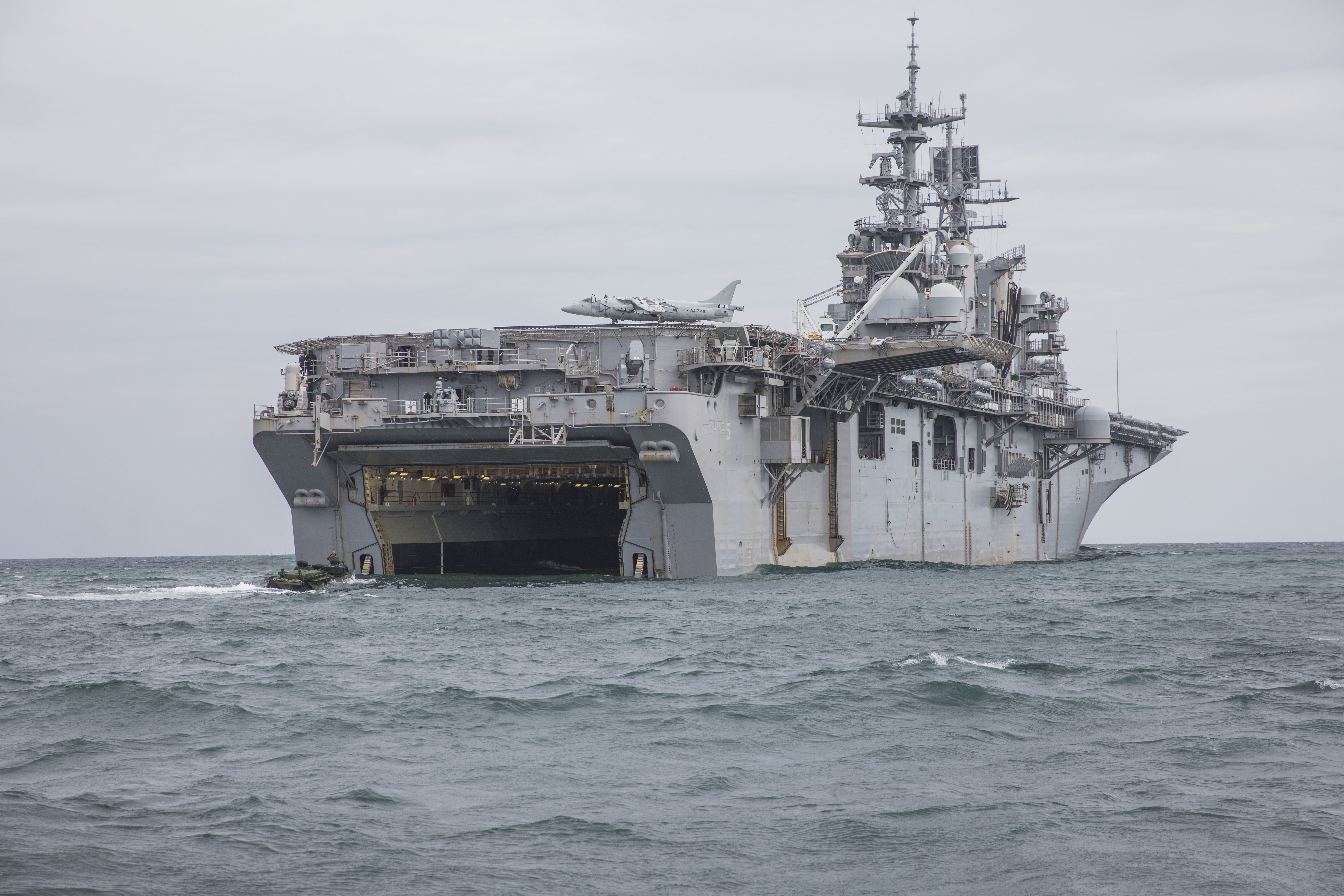
If China invades Taiwan, it may be with infantry with only minimal support from tanks.
Chinese strategists believe infantry is better suited for fighting in Taiwan’s mountainous and urban terrain, according to an analysis by Lyle Goldstein, director of the Asia Program at the Defense Priorities think tank in Washington, D.C. Perhaps more important, infantry and light vehicles could be transported by China’s vast fleet of civilian ships, rather than needing special landing craft to carry armored vehicles.
The People’s Liberation Army (PLA) believes it can “establish beachheads without heavy armor in the initial invasion wave,” Goldstein wrote. “This would allow them to heavily employ civilian craft that cannot carry heavy vehicles ashore.”
If this analysis is correct, than a Chinese invasion becomes far more feasible. To successfully invade Taiwan, China must grapple with a traditional problem of amphibious warfare: infantry storming a beach only have the firepower they can carry on their backs, while the defender enjoys the advantages of terrain, fortification and heavy weapons. Since World War II, one solution has been to land tanks and other armored vehicles that either swim ashore under their own power, or are transported by specialized landing craft. Indeed, a shortage of Landing Ship Tanks (LST) constrained Allied amphibious operations throughout World War II.
However, Goldstein argues that masses of Chinese light infantry – backed by heavy firepower from missiles, aircraft, drones and artillery as well as paratroopers and helicopters – could successfully land on Taiwan without the need for tanks. “My view is that tanks are nice to have but not really essential,” Goldstein told Uncommon Defense. “They are quite vulnerable to Javelin [anti-tank missile]-type weapons as well as kamikaze drones, and the Chinese are well aware of this. I think tanks would be involved, but light infantry would bear the brunt of the attack in small fast craft.”
In Goldstein’s timeline for a hypothetical Chinese invasion, the invasion would begin with a massive bombardment of Taiwan. “Within a few hours, 20,000 to 30,000 heliborne and airborne troops are on the ground, creating chaos and taking over key locations such as airfields and small ports,” he said. “Chinese mobilization begins in earnest at that point and the first landings take place 24 to 48 hours later, so maybe T + 2 days. Lodgments are solidified during T + 4 to 6, and then breakouts are initiated the following week. Nearly complete conquest takes 8 to 10 weeks.”
Key to this plan would be ensuring adequate sealift. China has a dozen or so major amphibious assault vessels – including the new 40,000-ton Type 076 class – plus numerous smaller naval landing craft. They would be joined by the China Coast Guard with around 500 ships, plus hundreds more vessels from the paramilitary People’s Armed Forces Maritime Militia. This force would be supplemented by China’s huge commercial fleet, including more than 5,000 merchant ships, as well as dozens of RO-RO (roll-on roll-off) ferries that can carry tanks.
But what would truly enable an infantry-centric invasion would be China’s 400,000 fishing boats. While they’re too small to carry vehicles, Goldstein believes they haul 500,000 troops to Taiwan over the course of a two-month campaign.
“Tens of thousands of fishing vessels would be too numerous to target with standard anti-ship weapons and could thus likely overwhelm Taiwan defenses,” Goldstein wrote.
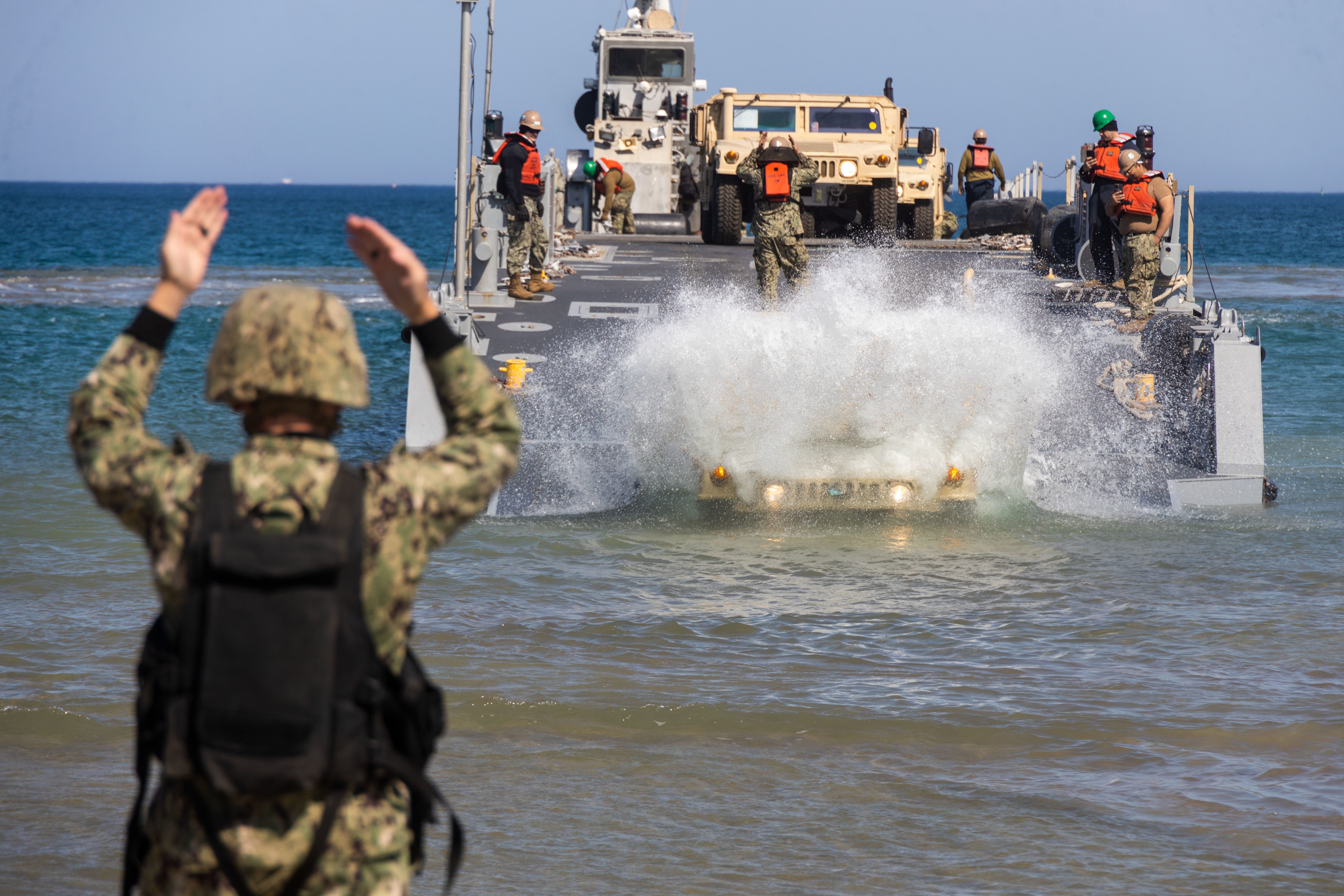
Such a strategy carries its own risks. “The downside for China is that small boat captains, despite being in a ‘maritime militia,’ are not active military personnel trained for combat and have never rehearsed an operation on this scale, making it a serious risk for the PLA to undertake,” wrote Goldstein. “And the greater vulnerability of small boats would make for heavy losses if they come under heavy fire from Taiwanese forces that have not been adequately suppressed by air cover and other methods of shore bombardment.”
Nor would China turn back the clock to pre-mechanized warfare. Special armored vehicles would accompany the initial assault waves to clear beach mines and obstacles. Follow-up waves would bring in tanks and armored troop carriers, a task made easier if the invaders can capture any ports. But rather than an armored blitzkrieg, PLA attacks would be made by infantry backed by intensive firepower, with tanks relegated to supported the foot soldiers.
But this approach does maximize China’s strengths: a regular military of 2 million personnel, plus reserves, paramilitary police and a huge pool of draft-age manpower. And, an arsenal of thousands of ballistic and other types of missiles, 3,000 combat aircraft, and a multitude of drones. Taiwan has 169,000 active-duty personnel and around 400 combat aircraft.
“The PLA is training hard for both urban warfare and also rough terrain,” said Goldstein. “They will bring some new and innovative tech to this battlefield such as micro-drones, as well as lessons from the urban, trench and bunker warfare in Ukraine.”
“But they also understand that this fight is largely about firepower and morale. They know they are likely to take very high casualties. Medical drills also show increased realism and intensity. By contrast, it is generally acknowledged by experts on Taiwan’s military that the ground forces are the weakest and most neglected of the services.”
Taiwanese coastal defenses could sink some Chinese landing craft, “but not nearly enough to stop the invasion,” said Goldstein. A defense-in-depth inland could prolong the campaign, but Goldstein said he is “skeptical that Taiwan can hold either on the beaches or inland, even with U.S. and allied help.”
Either way, an invasion armada of Chinese fishing boats evokes images of the Battle of Dunkirk, when a ragtag British flotilla evacuated 338,000 British and French soldiers. However, “Dunkirk was very spontaneous, disorganized, and rather lucky,” Goldstein said. “This would be similar in that it would feature lots of civilian craft, but different in that I expect it would be rather orderly. I think the Chinese have proven themselves to be quite good at both big jobs and at meticulous planning and training.”
This reads more like a plan for killing off china’s excess yoing men than conquering Taiwan.
The interesting thing about this scenario is it works similar to the Infiltration tactics Russia has been using against Ukraine. For China, the equivalent is having a constant stream of small boats putting soldiers ashore in disbursed and spread out landing spots - basically any random spot on shore they aren't getting shot from. The troops would have to advance forward on their own without support.
It has the potential of being very disruptive as Chinese soldiers could be almost anywhere on the island, and cause a great deal of havoc. I'm not sure that tactics could win an attritional war though, as the number of small boats sunk/destroyed would go up every day and the flow of new troops would drop very quickly.
Based on experience in Ukraine, there should be some way to model this out.