
For 75 years, South Korea has been preparing for a Second Korean War. An apocalyptic conflict where hordes of North Korean infantry and tanks storm across the Demilitarized Zone, covered by massive artillery and rocket barrages.
But what if South Korea is preparing to fight the last war – while North Korea is preparing to fight the next one?
North Korea is studying the lessons of the Ukraine War. Not just theoretically, but backed by first-hand experience from 15,000 North Korean soldiers – mainly elite special forces units – who fought for Russia in Ukraine.
One of those lessons will certainly be the vulnerability of armored vehicles to drones. And that’s bad news for South Korea, whose army relies heavily on tanks.
“KPA [Korean People’s Army] units have adapted and adjusted to the new style of warfare in Ukraine,” warned a recent analysis by the Royal United Services Institute, a British think tank.
North Korea is moving away from the Soviet- and Chinese-style tactics from the Cold War, which relied on massed troops, tanks and artillery to blast and bulldoze their way through enemy defenses. Instead, it is moving toward small-unit operations that have become the norm in Ukraine.
“The KPA’s foundational emphasis on offensive maneuver and asymmetric capabilities remains intact – but it is now scaffolded onto low-signature, networked, small-unit operations that differ from the mass maneuver tactics absorbed from Chinese in the Korean War,” said the RUSI report.
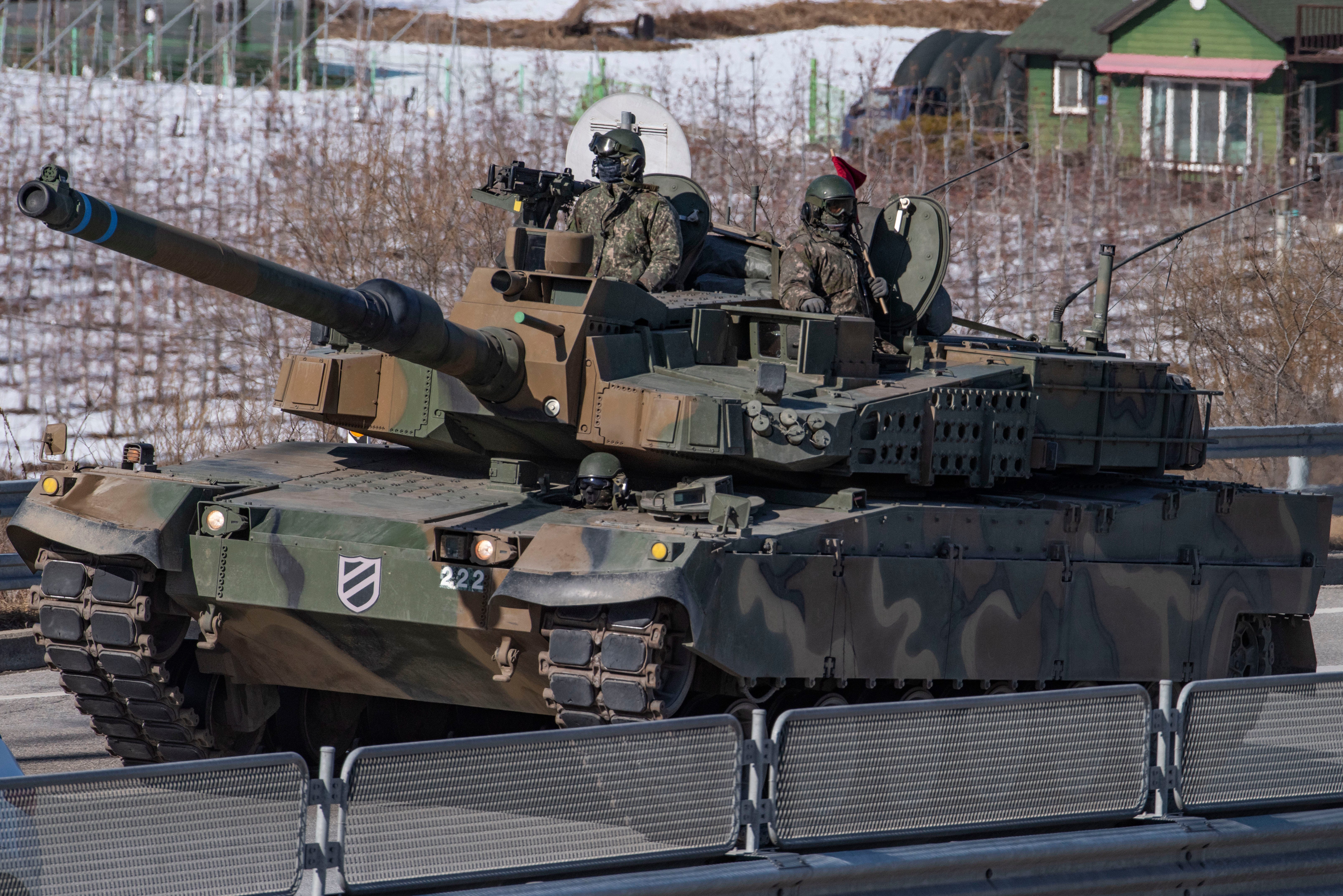
Ironically, the face of warfare is changing just as South Korea has built some of the most impressive tank forces in the world. The Republic of Korea Army has more than 2,100 tanks and 3,300 armored troop carriers (by comparison, Britain has around 200 tanks and 1,300 armored troop carriers). Indeed, South Korea has become a major armored vehicle exporter, with its K2 tanks and K9 self-propelled howitzers used by customers ranging from Poland to Vietnam.
Though the mountainous Korean peninsula isn’t ideal tank country, tanks proved useful in the Korean War as mobile artillery and bunker-busters. South Korea’s prime main battle tank – the Hyundai K2 Black Panther – has a special suspension system for operating in hilly terrain.
Today, South Korea “relies heavily on armored maneuver in order to deter and counter a North Korean offensive,” wrote Ju Hyung Kim, president of the Security Management Institute, a South Korean think tank.
Advanced tanks such as the K2 “constitute the core of South Korea’s forward-deployed armored defense north of Seoul. Mechanized divisions and armored brigades are designed to deter North Korea’s advancement in historically important locations, including Kaesong, Cheorwon, and the western corridor toward the Han River, and to execute a rapid counteroffensive maneuver.”
That’s classic doctrine for mechanized warfare since World War II. Yet there were similar expectations of mobile warfare when Russia invaded Ukraine in 2022. Four years later, drones have reduced armored vehicles to playing a minor role at best. Vehicles stay mostly under cover for fear of detection and destruction from omnipresent UAVs. Fitted with anti-drone cages, tanks now resemble porcupines or mobile chicken coops.
Ju Hyung Kim fears that drones – controlled by North Korea’s 200,000 special operations commandos – could devastate South Korean armor as well as U.S. mechanized forces stationed in Korea. “Tank units that execute counterattacks would encounter constant surveillance, especially in altitude bands below 1,000 meters where traditional air defenses are thinnest. Logistics convoys necessary to sustain armored counteroffensive would become objects of tracking and strike operations.”
Like the U.S. Army that it’s modeled on, the Republic of Korea Army has been accustomed to friendly skies. North Korea’s aging air force is no match for South Korea’s air force, especially when backed by U.S. airpower. Why invest in mobile anti-aircraft missiles and cannon when armored units can operate under fighter cover? Better to focus on North Korea’s 3,500 tanks and 22,000 artillery pieces.
But as demonstrated in Ukraine and more recently in the Persian Gulf, high-altitude jet fighters are not meant to stop swarms of low-altitude drones. Intercepting $20,000 Iranian Shahed UAVs with $4 million Patriot missiles is not just economically ruinous, but will exhaust missile stockpiles long before the attacker run out of drones.
At the least, South Korea will have to beef up its air defenses with affordable, mobile counter-drone systems such as lasers and microwave weapons, as well as jammers. Tanks are most effective when they are concentrated, but on a drone-saturated battlefield, they may have to operate dispersed.
However, this doesn’t mean that tanks are doomed to extinction in Korea. One reason why drones have become so overwhelming in the Ukraine War is their sheer numbers. Ukraine alone manufactures 4 million drones per year, a feat made possible by the country’s large number of tech innovators. With an economy that’s around one-fifteenth the size of Ukraine, North Korea would find it difficult to build such quantities even with Russian and Chinese help.
The Korean DMZ is about 160 miles long, or about the one-fifth the length of the frontline in Ukraine, with just a few invasion corridors traversing the rugged terrain. This would let South Korean and American forces concentrate anti-drone defenses, including new weapons such as lasers, microwave emitters, jammers and small interceptor drones.
Perhaps the biggest question is whether drone warfare would actually favor North Korea. What’s striking about the Ukraine War is just how indecisive drone warfare is. Despite launching drones by the millions, Russia has not conquered Ukraine, and Ukraine has not ejected Russia from its soil.
Instead, the conflict has become a stalemate, an endless war of attrition characterized by small units conducting small operations to capture small amounts of ground at heavy cost. On a battlefield where omnipresent drones make maneuver impossible, then the chance for decisive victory is lost.
With a far smaller economy and half the population of the South, the North does not want to fight a long war. Drones may be the future, but they don’t guarantee victory.
See Also:
China Has a Battle Plan to Defeat the U.S. Army

The last time that China and America fought a major ground battle was in the Korean War, almost 75 years ago.