
Will Ukrainians see the light? Under skies darkened by hordes of Russian drones, Ukrainians can hope for salvation could come in the form of lasers and microwave weapons. Neutralize the armada of UAVs that are pummeling Ukrainian troops and cities – and Russia’s plodding ground offensive falls apart.
But that vision is not yet practical. The problem is that directed energy weapons (DEW) have not yet matured to the point that they are a reliable defense against unmanned aircraft, according to a new report. If so, this has implications not just for Ukraine, but also for other nations turning to energy weapons.
“DEWs should not be a near-term investment focus for Ukraine,” warns a report by the RAND Corp. think tank. “Whilst DEWs are an appealing technological pursuit which can affect multiple targets at once and reduce reliance on munitions, these systems present significant practical limitations for Ukraine.”
“Current Ukrainian defense needs would be better served by other capabilities that can more immediately provide affordable mass,” RAND said.
This assessment may come as a surprise, given all the buzz about energy weapons for counter-UAS (C-UAS) defense. Several nations are pursuing high-energy lasers (aptly named HEL) and microwave weapons. Israel has just announced deployment of its Iron Beam, Britain plans to arm warships with the DragonFire laser, and China unveiled a mobile laser during a military parade in September (Ukrainian media claims that Russia is already using China’s Silent Hunter laser in Ukraine).
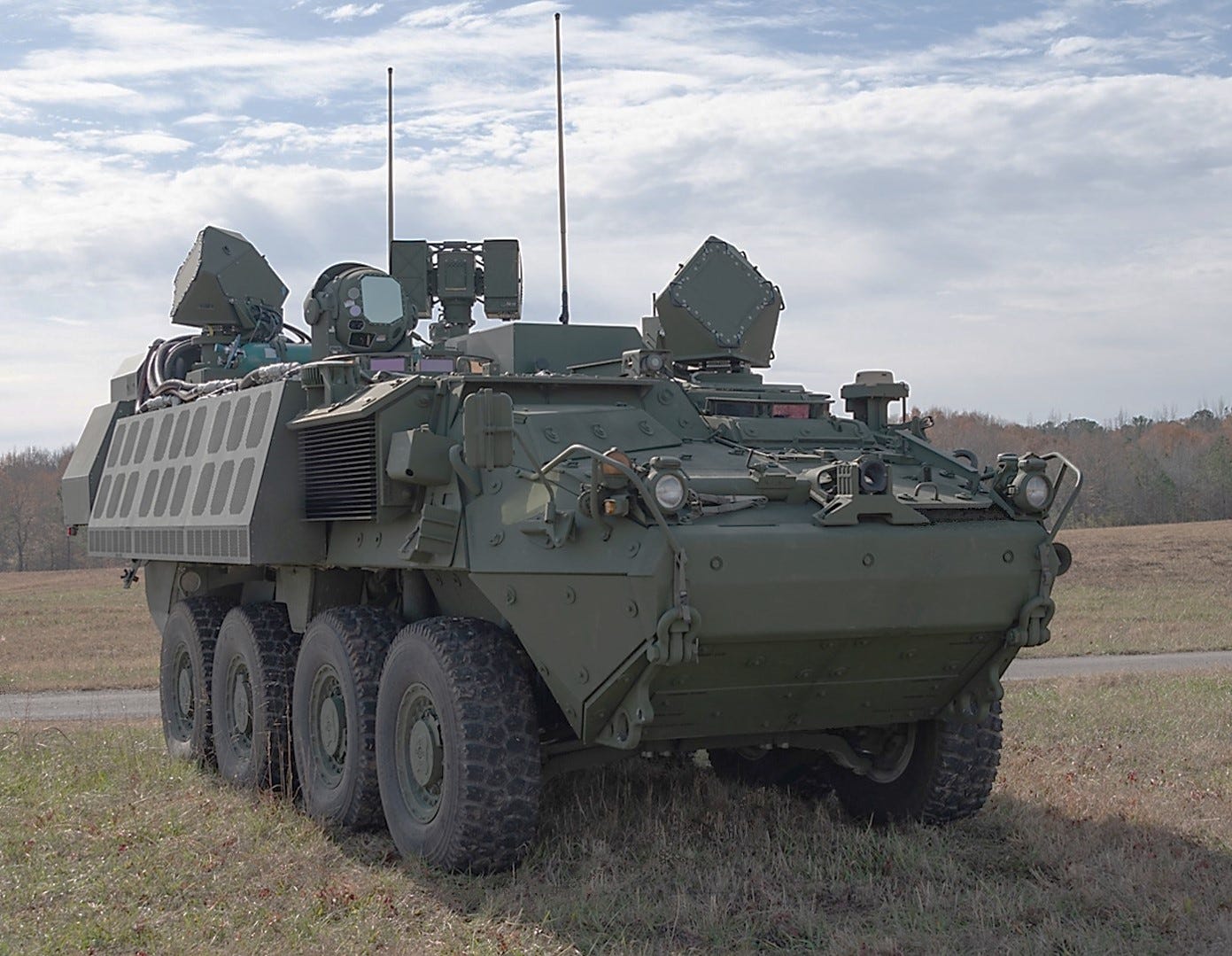
The U.S. has multiple DEW projects, including a 20-kilowatt truck-mounted laser, while the Marine Corps is developing mobile high-power microwave (HPM) weapons. Even Ukraine itself has developed and tested the Tryzub laser.
If drones are the future of warfare, then the attraction of energy weapons is obvious. They can zap drones – and rockets and artillery shells -- at a fraction of the cost of traditional air defense missiles and guns. Launching a million-dollar missile at a thousand-dollar drone is a losing proposition, especially for Ukraine, which is already desperately short of air defense munitions such as PAC-3 Patriot missiles. Even if the money were available, the manufacturing is not: with Russia producing an estimated 5,400 drones per month, Ukraine and its allies couldn’t churn out enough conventional air defense weapons to keep up.
In contrast, lasers may cost as little as $1 per shot, and they won’t run out of ammunition as long as there is enough electricity. Their beams travel at the speed of light, while microwave weapons can target multiple drones simultaneously.
Yet news military technology always means new teething pains. Just because weapons look good on the drawing board or on a test range doesn’t mean they are ready for battlefield deployment, or they can be manufactured in sufficient quantity to have a major impact.
RAND estimated the Technology Readiness Level (TRL) of many directed energy weapons makes them far from being operational. For example, the U.S. Army’s 300-kilowatt truck-mounted laser is only at TRL 4, or the proof of concept stage.
Some projects are further along the curve. RAND rates Israel’s 100-kilowatt Iron Beam laser and U.S. Air Force’s Tactical High-Power Operational Responder (THOR) microwave weapons at TRL 7, or a prototype tested in operational environment. Smaller, less powerful weapons tend to be more advanced: the 50-kilowatt DragonFire, BlueHalo’s 20-kilowatt Locust, and Epirus’s Leonidas HPM are around TRL 8 or 9, which means they are ready to be fielded.
Nonetheless, even the most mature directed energy weapons still face major obstacles before they can become the backbone of anti-drone defense. They guzzle electricity and require extensive cooling, especially lasers. “HELs generate a significant amount of waste heat; lasers are 50 per cent efficient at best and, especially with high-energy capabilities, the excess heat can cause major problems within the weapon itself and the platform it is mounted on if not managed correctly,” said RAND. This infrastructure “can be achieved at land bases and aboard large maritime platforms, but for smaller platforms it is not yet feasible.”
Other disadvantages include a short range, the need for a clear line of sight to the target, and beams that must lock on an agile drone for several seconds. Lasers also function best in clear skies free of rain, snow, fog and clouds, which hardly describes typical winter weather in Ukraine. For Ukraine, which has limited resources, receives fickle foreign aid, and is already facing masses of Russian drones, energy weapons may be a little too cutting-edge.
Nonetheless, investment in energy weapons is worthwhile, even if it’s not suitable for Ukraine right now. For example, Ukraine could modify industrial lasers and other commercial off-the-shelf products to create “an imperfect but good enough Tryzub model at sufficient scale to impact the battlefield,” Kiran Suman-Chauhan, who coauthored the RAND study, told Uncommon Defense. As part of an integrated air defense system that includes missiles and guns, energy weapons could be concentrated at vital points.
And whatever its lack of resources, Ukraine does have creativity and determination in abundance. “The Ukrainian armed forces have already demonstrated remarkable innovation in their approach to C-UAS, utilizing everything from simple shotguns to electronic warfare systems to counter drones on the battlefield,” Suman-Chauhan said.
Lasers and other energy weapons are likely to be the future of anti-drone defense. For Ukraine, the question is when that future will arrive.