
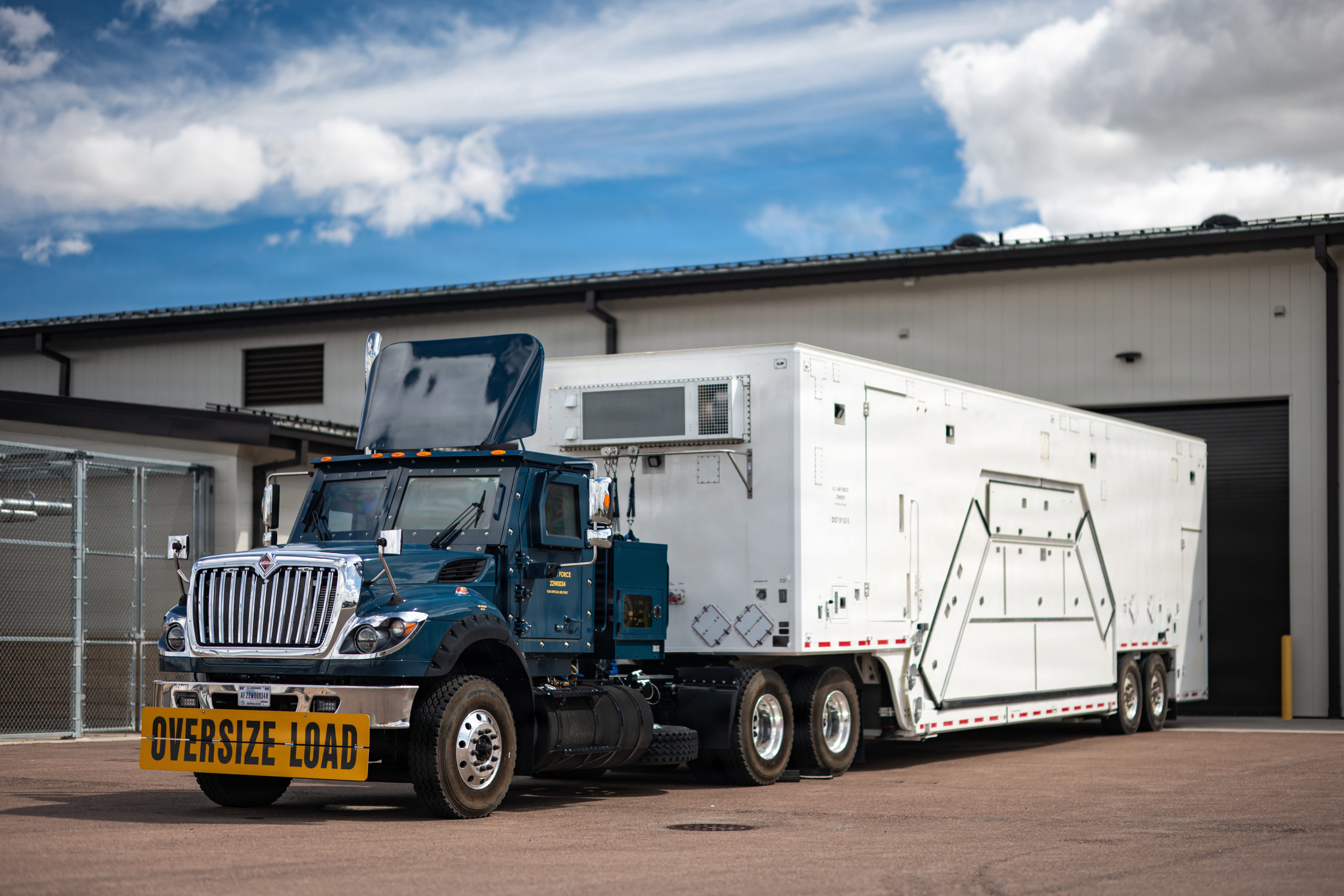
From missiles and nuclear warheads, to tanks and bullets, military cargo travels by truck on America’s highways.
Now the Pentagon fear that these trucks are vulnerable to drones.
The military and other government agencies have “requirements to move personnel and equipment on public roads that are at risk of surveillance and improvised attacks by drones,” warned a U.S. Air Force Small Business Innovation Research solicitation that asks industry to devise ways to protect military convoys on U.S. roads.
The Air Force wants a counter-drone system that can protect vehicles traveling at 70 miles per hour. The system would have sensors to detect and track drones, and determine whether they are following – “or are on a course for physical intercept” of – military convoys.
The goal seems to be a layered defense that would begin with non-kinetic countermeasures such as jamming drone guidance systems, and then resort to kinetic weapons “that produce effects that have a low probability of collateral damage.”
The system should also be easy to use. “Human teaming with the detection system should be intuitive and cognitively low effort, similar to an alarm system in a security operations center,” the solicitation said.”
Hijacking military trucks is a familiar theme in movies, especially if the plot involves some exotic cargo like a death ray. In reality, the military does take precautions. For example, the Air Force transports ICBM components via a Payload Transporter, an armored and booby-trapped vehicle that looks like a regular tractor-trailer. The Department of Energy has an Office of Secure Transportation that provides armed guards and escort vehicles to accompany special trucks carrying nuclear materials.
But this system was designed for the pre-drone era. Today, terrorists, insurgents, criminals and lunatics have easy access to drones that can be used for surveillance or weaponized into dropping bombs or as explosive-laden kamikazes.
Hezbollah, which is believed to have cells inside the United States, is using small drones to attack Israel. Mexican drug cartels regularly launch drones to transport drugs, spy on police, and attack rivals. Ordinary criminals use drones to smuggle contraband into prison and scope out potential targets for robberies.
No Hollywood screenwriter is needed to imagine a scenario where drones spy on a military convoy in preparation for a ground attack or hijacking. Or, a strike by explosive drones to destroy the trucks and their cargo.
When the Air Force describes the threat as “very challenging,” that’s an understatement. Within certain broad limits, Americans have a right to fly drones in public and private spaces, including highways. Beyond hostile actors, other groups may want to peek at military vehicles, from environmentalists and anti-nuclear activists to military buffs who want a photo of Army tanks headed toward a training range. “The open nature of our free society provides anonymity to our fellow citizens and potential bad actors,” the Air Force admits.
The U.S. military has a variety of counter-drone, or C-UAS, systems. The problem is that military anti-drone defenses are designed to operate on the battlefield, not Interstate-95 or Main Street. Kinetic means of destroying an unmanned aircraft – cannon, missiles, shotguns – can send stray rounds or shrapnel into other vehicles, or into homes and businesses along the roadway. Ramming a drone with an interceptor drone, or bringing it down with guns that snare a UAV in nets, can create debris that causes collateral damage.
“While kinetic (mass striking mass) solutions are legal they must be a final measure and must be employed in a way that minimizes risk to U.S. citizens in vicinity of the convoy,” it said. “This is especially difficult when a bad actor uses the cover of an urban or suburban area to employ their system to maximize clutter to sensors and complicate the engagement process (rules of engagement and establishment of intent) of kinetic solutions.”
On the other hand, non-kinetic systems also have their own problems. Jamming the command links between a drone and its operator can also disrupt cell phones, civilian radio and TV signals, GPS navigation – and hobbyists playing with quadcopters. Jamming is also ineffective against UAVs controlled via fiber-optic cable or equipped with AI guidance.
The Ukraine War has seen a host of bizarre anti-drone defenses, including “porcupine tanks” covered with iron bars to block explosive drones, or highways shrouded with nets to keep out snooping quadcopters. But a Mad Max-style truck rolling down the Jersey Turnpike would hardly be inconspicuous, and voters are unlikely to favor their local roads being draped in camouflage nets.
Ultimately, there may not be a perfect defense – or a defense the American people will accept – against a determined and resourceful attacker armed with drones. Nonetheless, there is a legitimate – perhaps even urgent – need to protect sensitive road cargo against a drone threat that grows more dangerous every year. The question is how to do so without turning freeways into free-fire zones.
I remember reading a Wall Street Journal article in the mid 90s about these semi trucks with booby trap trailers. Two armed drivers at all times. There is a strict procedure to open the trailer back gates so as not to start automatic gun fire built into the trailer along with other surprises.