
Beware of Pentagon agencies bearing gifts. Inside that innocent-looking shipping container could be hundreds of attack and reconnaissance drones, ready to emerge like a swarm of robotic bees.
When those drones complete their mission, they will return to the container to refuel and rearm, and then fly out again...and again...over several days. And all of this will be automated, with no humans present.
Or, at least that’s the vision of the technologists at the Defense Advanced Research Projects Agency, the Pentagon’s research arm. DARPA wants autonomous containers that can launch, recover, supply and then relaunch “constellations” – or swarms – of up to 500 drones.
Drone swarms are emerging as one of the deadliest weapons in the 21st Century. Hordes of quadcopters – coordinated by AI to strike from multiple directions simultaneously – threaten to overwhelm tanks, artillery, ships and other traditional weapons.
Indeed, DARPA outlines an intriguing – if slightly frightening – scenario in its Request for Information, which is intended to solicit ideas from industry. The scenario involves a remote-controlled container that – when activated -- “autonomously deploys a series of platforms [drones] launching from a single area (possibly serially). The platforms traverse some radius away, loiter on-station with an active payload (not all necessarily in the same location nor same payloads), and execute a mission before returning back to the launch area, autonomously recovering, recharging/refueling, and launching again to repeat the mission (without human intervention).”
The idea of drones-in-a-box isn’t new. Most famous is Ukraine’s “Operation Spider’s Web” in June 2025, in which drones were hidden aboard cargo trucks that snuck into Russia over 18 months. The drones were launched in a surprise strike that destroyed or damaged as many as 40 Russian aircraft, including precious Tu-22 and Tu-95 strategic bombers. Perhaps more significant was that containerized drones enable Ukraine to strike Russian airbases 3,000 miles away in Siberia, far beyond effective strike range of UAVs launched from Ukrainian territory.
Naturally, with its vastly bigger defense budget and resources, America wants to go one step further. The Pentagon essentially wants to create portable drone bases that can be dropped in remote locations and function without humans on site.
This raises all sorts of possibilities. For example, drone-filled shipping containers could be covertly left near sensitive installations such as ICBM sites, airbases, defense factories, and military and political headquarters.
Indeed, in February, the Pentagon’s Defense Innovation Unit released a proposal for a Containerized Autonomous Drone Delivery System. CADDS is intended to “exist in a dormant state for a period of time and launch UAS upon command.”
Perhaps not coincidentally, the DARPA and DIU projects come after Chinese company DAMODA unveiled a shipping container packed with 648 drones. DAMODA also wowed observers with a record-breaking 15,947 drones that performed a coordinated lightshow in the skies over Chongqing.
DARPA is less impressed with that feat. “While sufficient for preplanned lightshows and commercial activities, further advancements are required to exploit constellation technologies in a high platform density and rapid deployment scenario,” the RFI reminded readers.
For example, DARPA wants drone containers that can function where GPS isn’t available. This would allow operations where GPS is jammed, or deployment in mountainous or other rugged locations where GPS coverage may not be available.
Either way, DARPA believes current storage containers can’t do the job because they require humans to handle launch and maintenance. They also don’t have the right internal configuration to accommodate equipment for communications and recharging.
DARPA isn’t fixed on using standard containers such as Conex and ISU. “Innovative ideas and non-standard containers (e.g. suitcase-based distributed systems, box-based systems) will also be considered within the context of the presented approach, but solutions should be compatible with current military transport capabilities,” the RFI said.
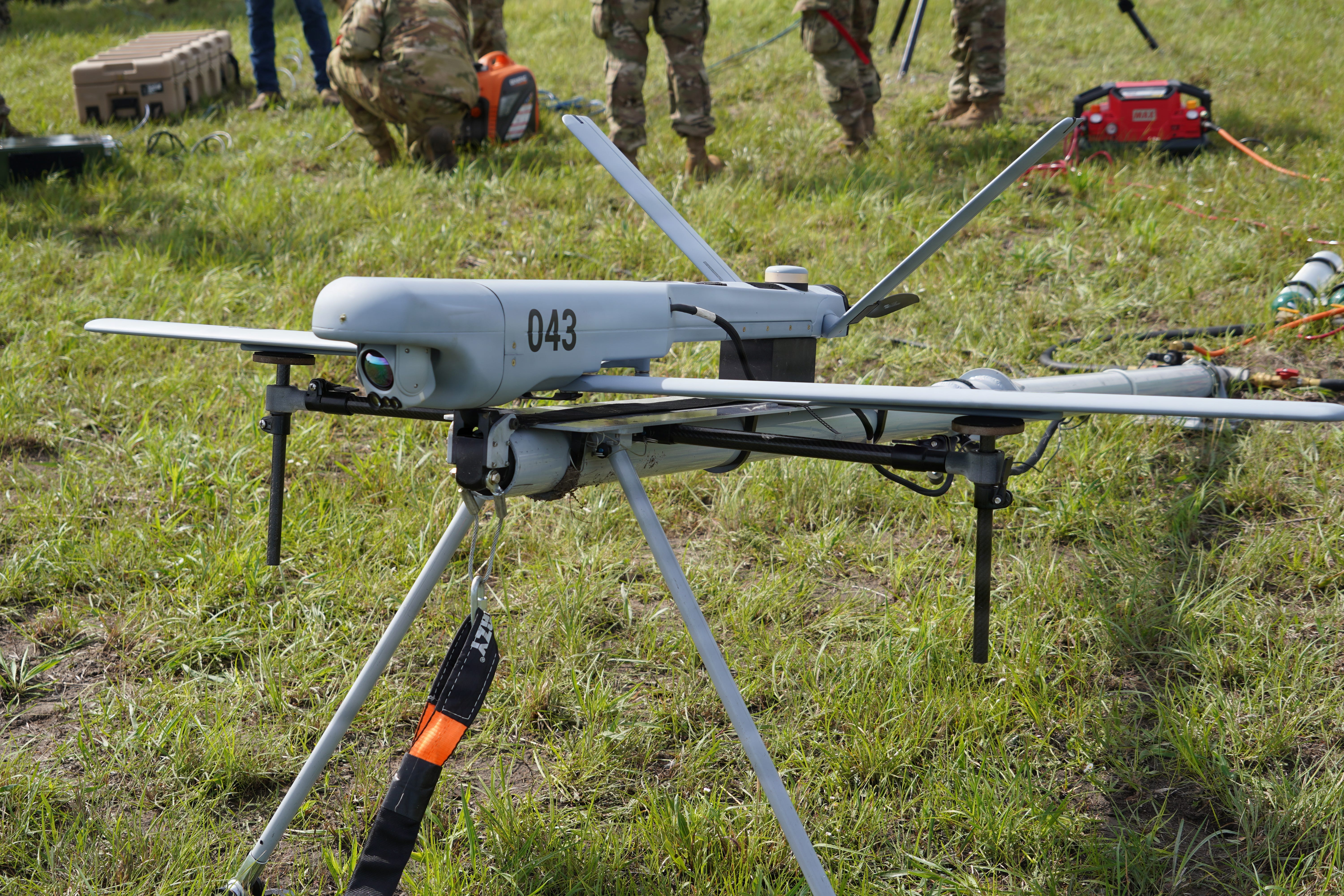
In addition to a new launch container, DARPA wants a new kind of drone. The agency is not satisfied with the container-launched drones now offered by multiple companies. Current electric-powered UAVs have limited battery power, while hybrid-electric propulsion is heavier and more complicated, according to the agency. “While some constellation delivery solutions can unleash hundreds of drones in under a minute, these platforms often lack the ability to integrate external payloads, with their additional SWaP [size, weight and power], that enable meaningful effects/surveillance,” DARPA said.
Instead, DARPA is looking at new kinds of small- to medium-sized drones in Groups 1 to 3 (0 to 1,300 pounds gross takeoff weight). While the RFI doesn’t mention quadcopters, it does note that fixed-wing designs are too large for containers and can’t hover.
Whatever drone design is chosen, it should function at Autonomy Level 4, which means a human operator merely assigns a mission, and the drone handles the rest. They will be launched and relaunched from containers that can sustain drone swarm operations over several days. The system would include AI that would handle functions such as coordinating the various drones, avoiding collisions, and optimizing flight paths.
With containerized drones already a reality, the question is how far humans will extend the concept. A future where every box --whether parked in a field or on a street -- has to be treated as a potential threat, is a grim one.
That sounds terrifying and a potential threat to the US homeland. What defenses would we have at the moment against something like that?!?